ARIA: Augmented Reality Intelligence for Apparel to close the loop of sustainable fashion
Project Idea Metadata
- Project Idea Name: ARIA: Augmented Reality Intelligence for Apparel to close the loop of sustainable fashion
- Date: 4/16/2026 7:46:59 PM
-
Administrators:
Project Idea Description
The fashion industry's sustainability crisis is not a technology gap it is a decision timing problem. The choices that determine the majority of a garment's environmental footprint (material selection, construction methods, supplier sourcing) happen during the design stage, weeks or months before any sustainability assessment is performed. By the time LCA reports are produced, design decisions are frozen and modification is commercially unviable. A parallel problem occurs downstream. Wholesale buying the moment when retailers decide which products will actually reach consumers is today conducted largely on aesthetic and commercial criteria. Sustainability data exists in corporate systems, but it is rarely visible, comparable, or actionable at the point of purchase. The result is an assortment selection process that systematically ignores the environmental dimension, contributing to overproduction, unsold inventory, and end-of-season waste. Between these two broken moments, design and buying, lies a third structural failure: no feedback loop. Signals from the market (what buyers choose, which sustainability attributes influence decisions, what gets ordered vs. rejected) do not flow back to the design team in any structured way. Each collection starts largely from scratch, repeating the same blind decisions. ARIA proposes that integrating real-time lifecycle intelligence and AR visualisation into a single end-to-end decision environment, spanning design, wholesale showroom, and feedback, can fundamentally shift sustainability from a post-hoc compliance obligation to an active, operational decision criterion. The system connects three stages: Stage 1 Eco-design cockpit. Designers and product managers work in an integrated environment where every choice of material, supplier, or construction triggers an instant LCA and circularity response. Instead of receiving a sustainability report after the collection is finalised, the design team sees impact scores, durability indicators, and circularity compatibility in real time for each variant, as the decision is being made. AR and 3D visualisation of garments under development replaces a significant share of physical development samples, reducing both the material cost and the environmental impact of the prototyping cycle. A collection arrives at the showroom stage with its sustainability profile already verified and embedded in the product data layer. Stage 2 AR wholesale showroom. Buyers and agents explore the collection through professional-grade AR accurate to material texture, colour, and construction without the need for physical samples across international markets. The buying experience integrates a Sustainability Scorecard for each product, enabling buyers to compare variants not only on aesthetics and price but on verified environmental indicators. The system targets a 60–80% reduction in physical sample volumes while preserving the tactile value of hero pieces and innovative materials. This directly reduces sample production waste, international logistics emissions, and end-of-season sample disposal a CSRD-relevant and EPR-relevant impact vector. Stage 3: Structured feedback loop. Every interaction in the AR showroom generates structured data: which products buyers compare, how long they spend on sustainability-attributed variants, which circular indicators influence or fail to influence ordering decisions. These signals return to the design team as input to the next collection brief a closed loop between market behaviour and eco-design that does not currently exist in the industry. The radical claim is not that this feedback loop is technically complex, but that it has never been built as a native feature of the design-to-market process. The hypothesis behind ARIA is simple but consequential: if sustainability intelligence is embedded as a native layer across design, buying, and feedback rather than added as a reporting obligation after decisions are made the fashion industry's default mode of operation can shift. Not through regulation alone, but through the practical experience of making better-informed decisions at each stage of the collection cycle. The project will explore how AR technologies, real-time lifecycle assessment, and structured buyer interaction data can be combined into a practical, operational tool and whether making sustainability visible, comparable, and consequential at the right moment in the process is sufficient to shift choices across the value chain.
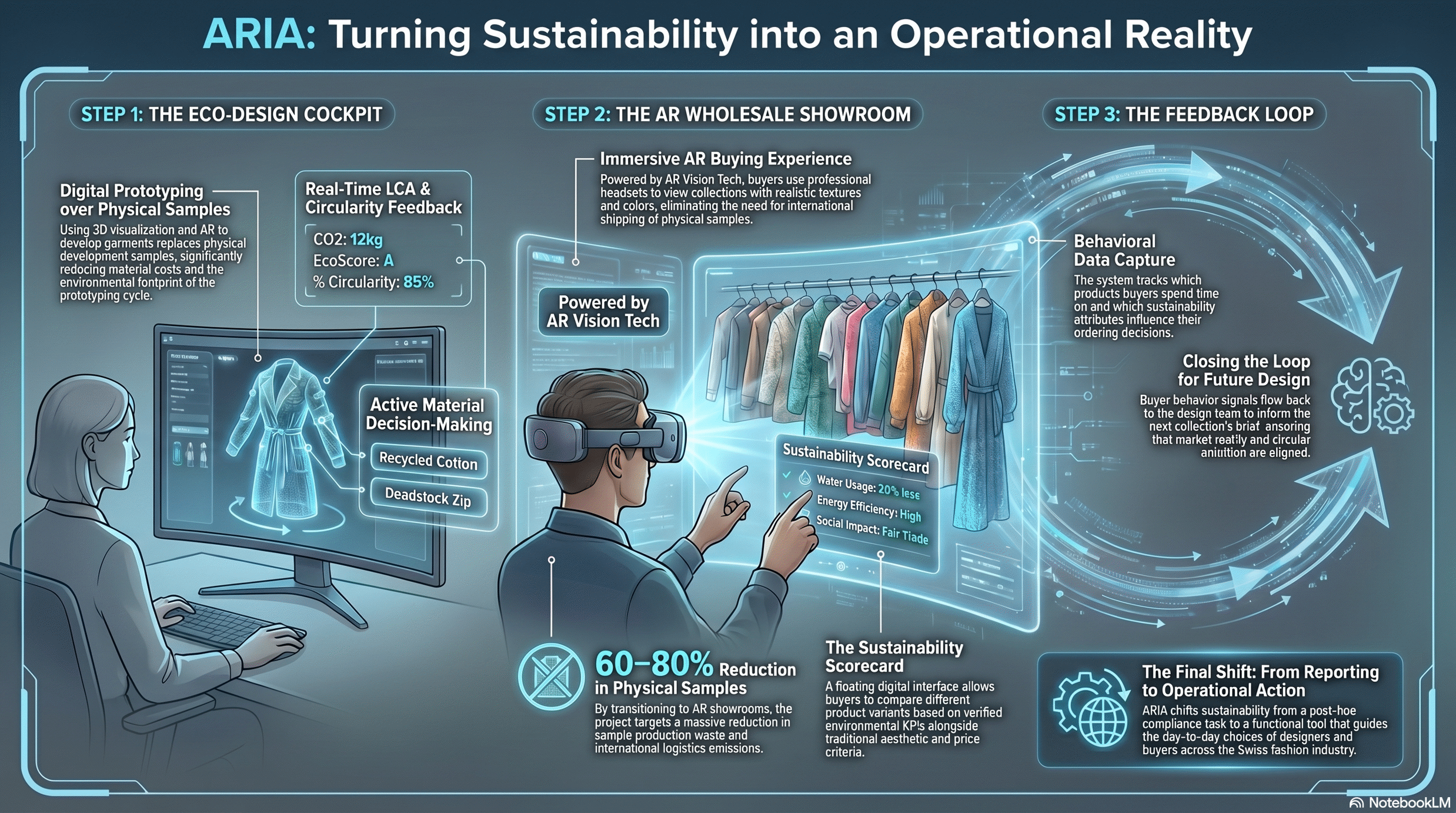
ARIA proposes an end-to-end AR-powered decision environment connecting three stages: (1) an eco-design cockpit where designers receive real-time LCA and circularity feedback as they specify materials and construction; (2) an AR wholesale showroom that replaces physical samples reducing sample waste, logistics emissions, and lead times while embedding sustainability intelligence into the buying experience; (3) a structured feedback loop capturing buyer behaviour signals to inform the next collection's design brief. The hypothesis: embedding sustainability as a native decision criterion not a compliance layer at the design and buying stages can measurably reduce overproduction, sample waste, and the structural gap between circular ambition and purchasing reality in the Swiss Fashion industry.