Leveraging local climate-smart plant-based materials for the textile industry
Project Idea Metadata
- Project Idea Name: Leveraging local climate-smart plant-based materials for the textile industry
- Date: 3/24/2026 6:38:03 AM
- Administrators:
Project Idea Description
Identify innovative crops with strong agronomic potential regarding the climate crisis, enabling the repurposing of agrofood by-products for the textile industry. Their versatile uses (food, energy, textiles, dyeing...) would contribute to the advancement of an eco-responsible society while addressing current resilience challenges in the agro-food sector.
Examples of innovative plants/crops for Switzerland include: sorghum (Sorghum bicolor), miscanthus (Miscanthus giganteus) and kenaf (Hibiscus cannabinus). Traditional plants that deserve to be included in varietal improvement programs in order to achieve better yields and overall results regarding the current climate crisis include: hemp (Cannabis sativa) and flax (Linum usitatissimum).
Native local wild plants like nettle (Urtica dioca) could be used as ramie (Boehmeria nivea) for textile purposes too.
Create an innovative textile sector from these best suited crops and agro-food by-products.
A chain of clothing stores will be flourishing across Switzerland in a few years. Featuring a new range of clothing created entirely from organic plant-based textiles made from local products and by-products in Switzerland.
Finally a large-scale recycling approach that transforms these fully biodegradable unusable clothes at an industrial, municipal, and institutional level through professional aerobic composting will be included with the objective of humus formation for soil regeneration.
Problems to get solved:
1 The textile industry has significant impact on the environment:
There is a significant pesticide pollution emerging in water and soil linked to cotton cultivation. As well as chemicals and microplastics (microfibers and PFAS) released into water during textile finishing and every wash of synthetic fabrics. There is globally high water requirements for the cotton cultivation (depletion of water resources and water pollution). In addition, the carbon footprint of polyester and animal textile products (leather, sheep wool) is harmful.
- Requires high water resources for farming, processing
- Processing generates significant pollutions
- Generates soil, water and air pollutions
- High use of pesticides and fertilizers in conventional farming
- Fast fashion industry generates negative side streams; this leads to ecosphere pollutions, high carbon footprint and health issues.
2 There is no local plant-based climate smart textile industry in Switzerland
- High production costs
- Lack of knowledge
- Climate-smart cultivation is not established yet
- Lack of awareness
- Local cultivation of most tropical textile crops is currently not possible (cotton, kapok, vegetable ivory, jute, ramie, raffia…); because the Swiss climate conditions are clearly not matching, and because of high water requirements, this lead to a delocalization of these crops production.
Our solution:
Creation of an alternative and innovative textile industry using next generation materials, from local, climate-smart and resilient crops.
Introduction of a new crops sector in Switzerland with : sorghum, kenaf, miscanthus and leveraging of agro-industrial side-products (from fiber to composite). And revalorization of hemp, linen and nettle.
Creation of a new product for the Swiss market: ”Regen-Vtex©” is based on eco-local climate-smart plant-based textiles
Our solution shows self-sufficiency in terms of climate smart textiles production when projecting into a post-oil era context
Relocation of the entire textile production to Switzerland by creating a fully intelligent supply chain (eco-design).
Our solution does not aim to recycle already produced textiles (cotton, polyester, etc.) into second-hand garments and repurpose them.
Instead, it aims to focus on innovative, multi-purpose crops (food, textiles, etc.) that do not require an excessive footprint in terms of production land and at the same time to add value to by-products from the agri-food industry and agriculture.
Our holistic approach would therefore allow us not to recycle textiles into end-of-life garments, but to recycle them through professional aerobic composting and the formation of humus for the soil regeneration (fully compostable clothing).
Textile production could shift away from resource-intensive monoculture by using regional crop residues. Innovations allow the use of waste streams from various local material; cereal straw, apple cake and hemp processing to be transformed into high-value cellulosic and biosynthetic fibers (bacterial cellulose, mycoproteins, mycelium textiles).
Needs of Fashion & Lifestyle industry:
In 2018 the Federal Office for the Environment (FOEN), the State Secretariat for Economic Affairs (SECO) as well as the associations Swiss Textiles and amfori initiated the initiative Sustainable Textiles Switzerland 2030. This simply shows us the needs and demand for the establishment of such an innovative sector.
Customers:
Initially a high-end niche market, high fashion, could then be applied to a larger mass of consumers, particularly in the event of a major energy and hydroclimatic crisis.
Vegan customers, eco-aware customers.
Benefits:
Improved health, environment and self-sufficiency
Sustainable development:
Our idea contributes to a more sustainable and healthy climate-resilient society, from textile production all the way to clothing and soil regeneration.
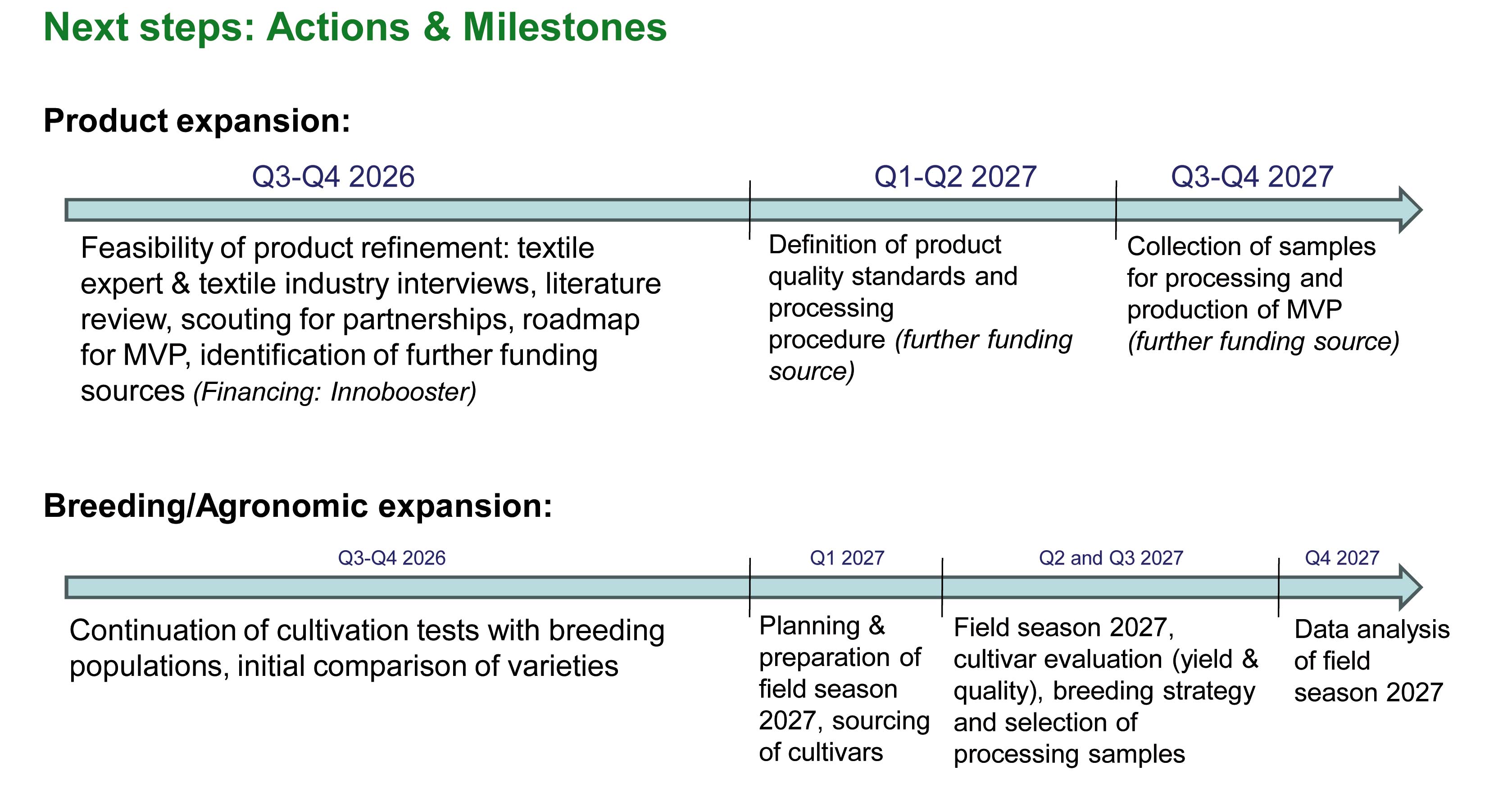
Idea workplan:
Risks:
At the crops production level:
•Little knowledge about innovative textile crops production under Swiss growing conditions (yield & quality)
•Lack of adapted equipment for harvesting and processing
•Investment in production machinery may be too high
At the crops processing level:
•Processing expertise and facilities are not available in Switzerland
•Quality profile of these new textiles may not be adapted to local preferences
•Fashion industry may not be ready to invest in new textile source
•Customers may not be willing to pay more for a local and sustainable eco textile
Resources:
Our current estimate of required resources and work packages is not yet precise, as it depends on the exploration phase and the transformation solutions and partners we may identify. Based on our modest experience in Switzerland, we estimate that approximately CHF 12,000 would be needed to create a promising prototype, and a further CHF 12,000 to compensate the research partners and project team members involved in the project.
In case we win the application, we will clearly try to spend most of the funds on prototyping a product.
The Innovation Booster – Fashion & Lifestyle can greatly support us by providing coaching and by sharing knowledge and professional networks.
Identify innovative crops with strong agronomic potential regarding the climate crisis, enabling the repurposing of agrofood by-products for the textile industry. Their versatile uses (food, energy, textiles, dyeing...) would contribute to the advancement of an eco-responsible society while addressing current resilience challenges in the agro-food sector.
Create an innovative textile sector from these best suited crops and agro-food by-products.
A chain of clothing stores will be flourishing across Switzerland in a few years. Featuring a new range of clothing created entirely from organic plant-based textiles made from local products and by-products in Switzerland.
Finally a large-scale recycling approach that transforms these fully biodegradable unusable clothes at an industrial, municipal, and institutional level through professional aerobic composting will be included with the objective of humus formation for soil regeneration.